Financial Statement Analysis
Extract financials, compute ratios, compose statements, and review valuation reports for analysts.
Skills in this bundle
StatementWright
Digitize a financial statement document (BS/IS/CF) into the canonical line schema (LLM-mapped, regex fallback) and run accounting tie-outs (assets=liabilities+equity, gross profit=revenue-cost). Feeds ratio analysis.
RatioWright
Pure deterministic financial ratio analysis from statements (accepts an upstream statement-extractor JSON or a raw document): debt ratio, current ratio, net margin, ROE.
Statement Maestro
Builds the three primary financial statements from a trial balance: income statement and balance sheet (fully computed, China-GAAP account-code mapping) plus an indirect-method cash-flow skeleton, with assets = liabilities + equity tie-out and review next-best-actions (actions.json).
Listed Co Finance
Query A-share / Hong-Kong listed company financials: three statements, ratios, peer comparison, multi-year trends. Powered by akshare.
Comps Review Critic
Comparable-companies (trading multiples) valuation: computes EV/EBITDA, EV/Revenue and P/E across a peer set with median/mean stats, then applies median multiples to the target's metrics to derive an implied valuation range, plus review next-best-actions (actions.json).
See it in action
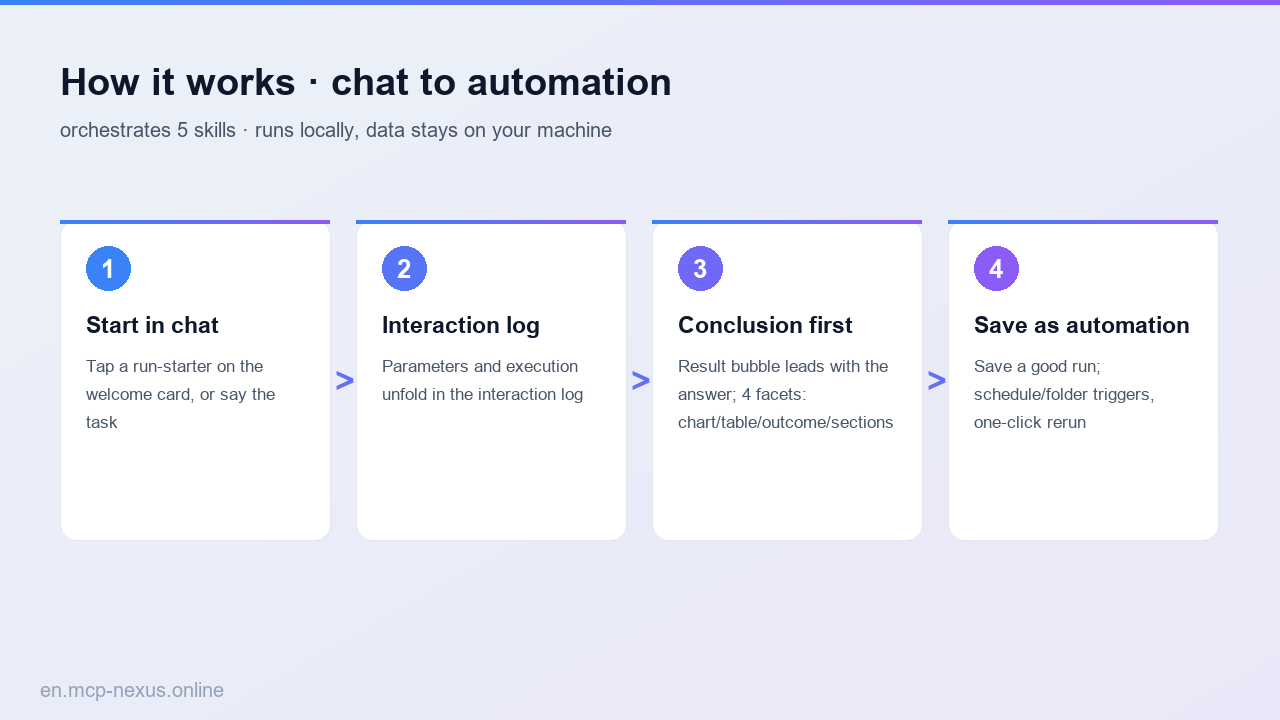

MCP Nexus chains statement extraction, ratio analysis, statement composition, and valuation review into one workflow, moving analysts from keying data to reading conclusions.
- Auto-extracts and structures the three statements, with no manual transcription.
- Computes and interprets profitability, solvency, efficiency, and growth ratios in one click.
- Composes standardized statements and peer benchmarks automatically.
- Reviews valuation reports, flagging assumption and tie-out issues upfront.
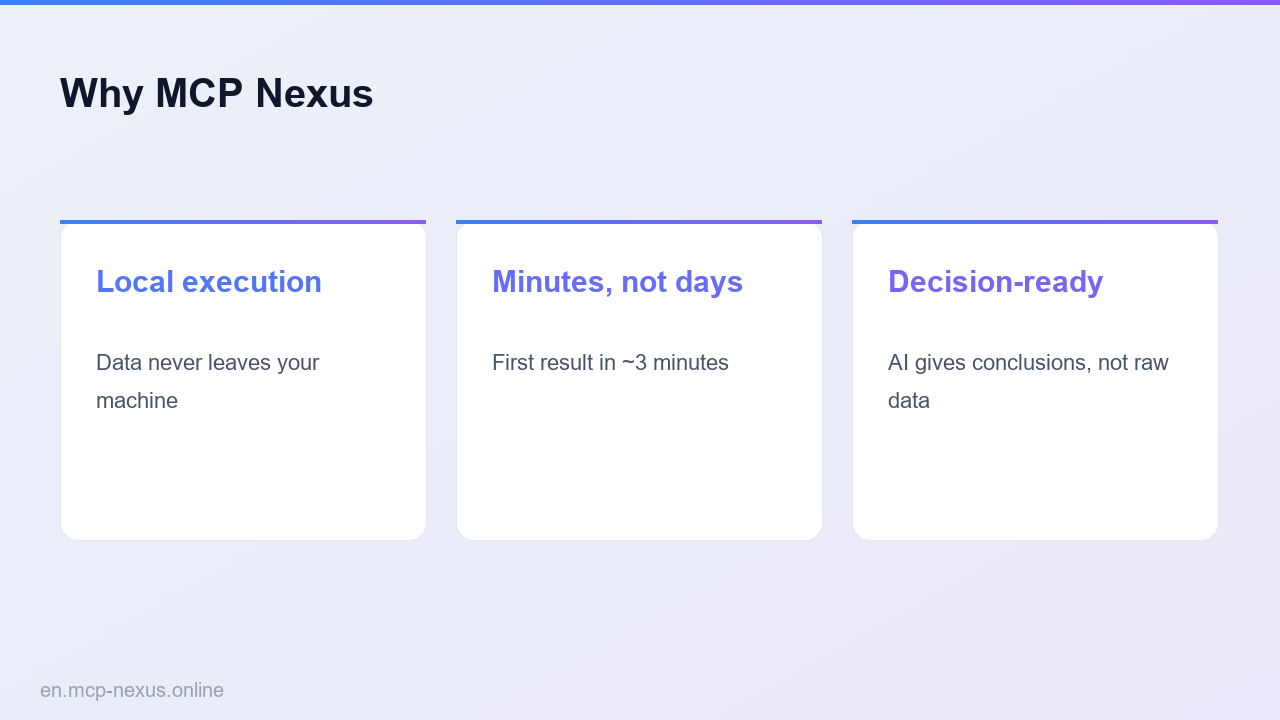
- Runs on your machine; financial data stays in your network and conclusions are traceable.
What is financial statement analysis with MCP Nexus
Financial statement analysis extracts data from statements, computes key ratios, and forms judgments about performance and risk. MCP Nexus chains statement-extractor, ratio-analyzer, financial-statement-composer, listed-company-financials, and valuation-report-reviewer to automate extraction, computation, composition, and review. It suits financial analysts, investment research, credit, and audit teams, running fully on-premises.
How it works
MCP Nexus vs alternatives
| MCP Nexus | Manual / Excel | Generic AI / Cloud tools | |
|---|---|---|---|
| Pricing | Free tier, metered by calls | Many analyst hours | Per-seat plus per-volume fees |
| Local execution | Yes, data stays on-premises | Manual process | No, data leaves your network |
| Setup time | Minutes to first analysis | Days, experience-dependent | ~1 week integration and training |
Real use cases
FAQ
Which statement sources are supported?
PDF/Excel statement imports and listed-company financial pulls, with the three statements auto-extracted and structured. All processing runs locally.
Which ratios are computed?
Profitability, solvency, operating efficiency, and growth ratios, with trend and peer-benchmark interpretation and abnormal metrics flagged.
Can composition match our conventions?
Yes. Statement templates and account mapping are configurable, supporting custom conventions and peer-benchmark dimensions, exporting to Excel/PDF.
What does valuation review check?
It reviews assumption reasonableness, tie-out relationships, and sensitivity, flagging issues upfront for analyst judgment and correction.
How is data security ensured?
Everything runs on your machine; financial data never leaves the network, with private deployment and conclusions traceable to source statements.