Journal Entry & Bookkeeping
Compose journal entries, vouch and reconcile, extract statements, and run ratio checks for the close.
Skills in this bundle
Entry Scribe
Accounting journal-entry composer: generates balanced double-entry journals by type (accrual / depreciation / prepaid amortization / manual) from source data, checks debit=credit, and emits posting/approval next-best-actions (actions.json). (Action Co-pilot: generates next-best-actions (actions.json), follow-up tasks and calendar reminders on top of the analysis — what to act on today.)
Voucher Auditor
Auto-generate ERP-compatible accounting vouchers from source documents (expense / purchase / sales).
StatementWright
Digitize a financial statement document (BS/IS/CF) into the canonical line schema (LLM-mapped, regex fallback) and run accounting tie-outs (assets=liabilities+equity, gross profit=revenue-cost). Feeds ratio analysis.
Fund Reconciler
Upload a bank statement and journal file (Excel/CSV) to run automated reconciliation across 9–11 matching scenarios. Outputs an Excel report with 4 sheets: summary statistics, matched records, unmatched journal entries, and unmatched bank transactions. Deep mode adds LLM-generated analysis.
RatioWright
Pure deterministic financial ratio analysis from statements (accepts an upstream statement-extractor JSON or a raw document): debt ratio, current ratio, net margin, ROE.
See it in action
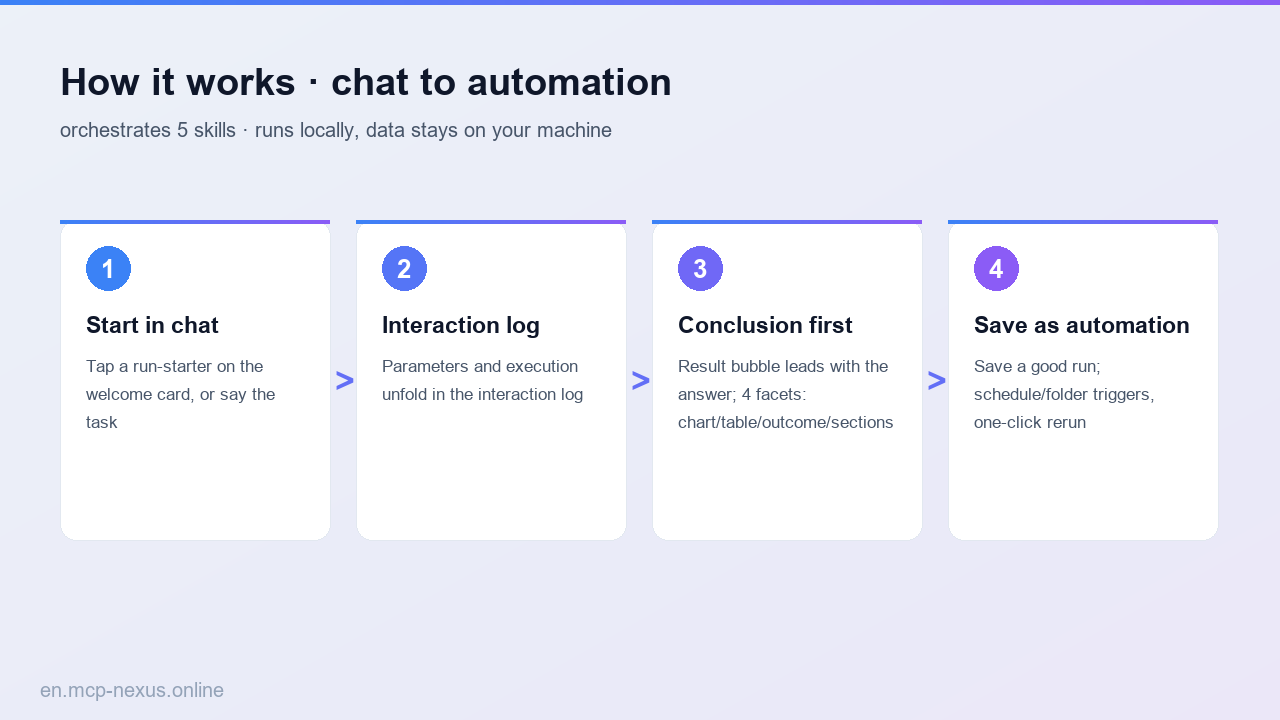

MCP Nexus chains journal-entry composition, voucher auditing and reconciliation, statement extraction, and ratio checks into one workflow, turning the month-end close from overtime crunch into a minutes-long loop.
- Composes journal entries by business rules, auto-validating debit-credit balance.
- Runs voucher auditing and funds reconciliation in one click, flagging differences line by line.
- Auto-extracts statement line items and checks period-end tie-outs.
- Built-in key-ratio checks surface abnormal swings early.
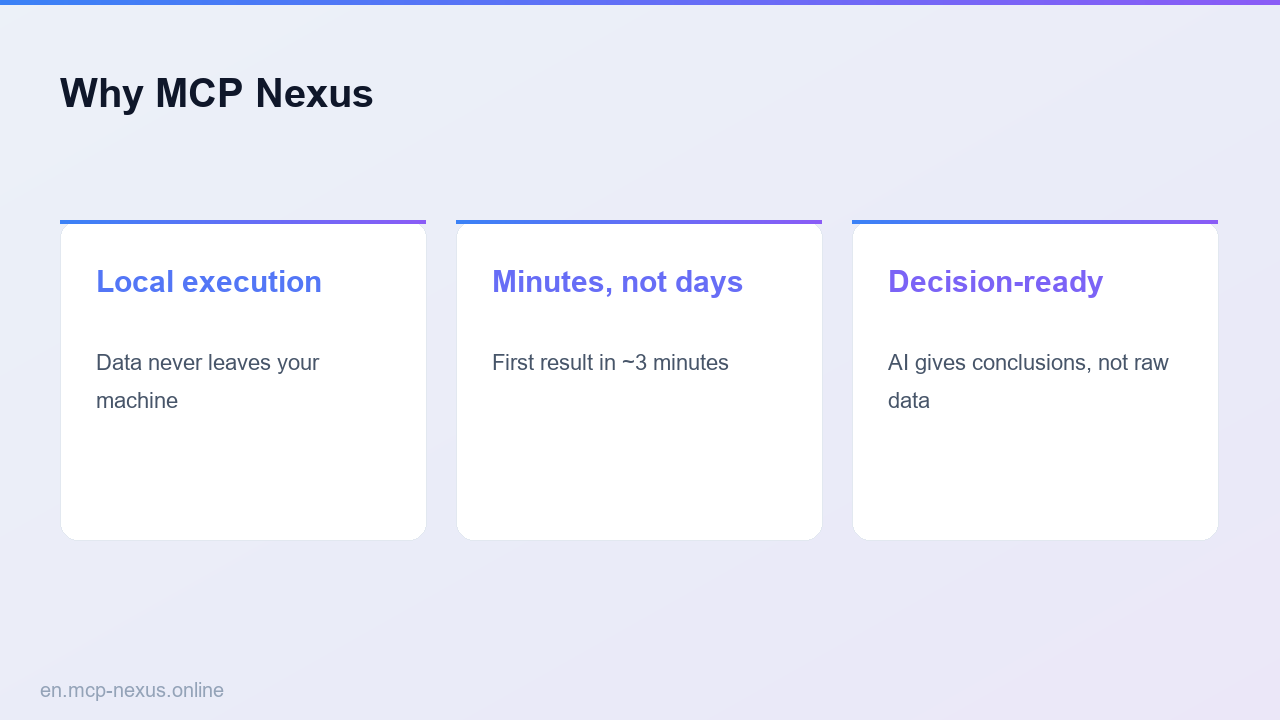
- Runs on your machine; accounting data stays in your network and entries are traceable.
What is journal entry & bookkeeping automation with MCP Nexus
Journal entry and bookkeeping automation automates entry composition, auditing, reconciliation, and period-end checks to speed the month-end close. MCP Nexus chains journal-entry-composer, voucher-auditor, statement-extractor, fund-reconciler, and ratio-analyzer to automate the path from posting entries to producing statements. It suits general-ledger accountants, shared-service centers, and internal audit, running fully on-premises with no data leaving your network.
How it works
MCP Nexus vs alternatives
| MCP Nexus | Manual / Excel | Generic AI / Cloud tools | |
|---|---|---|---|
| Pricing | Free tier, metered by calls | Many GL-accountant hours | Per-seat plus per-volume fees |
| Local execution | Yes, data stays on-premises | Manual process | No, data leaves your network |
| Close cycle | Minutes-long loop | Days of overtime crunch | Varies by plan |
Real use cases
FAQ
Which business data is supported?
Business transactions, bank statements, and entry rules (Excel/CSV), with transaction types auto-identified and mapped to accounts. All processing runs locally.
Can entry rules be customized?
Yes. Transaction-to-account mapping rules are configurable, composing entries and validating debit-credit balance, with custom templates supported.
What does auditing check?
Debit-credit balance, attachment completeness, account plausibility, and duplicate vouchers, with exceptions reason-tagged for correction.
Can it speed the close?
Yes. Composition, auditing, reconciliation, and period-end checks chain automatically, compressing the close from overtime crunch into a minutes-long loop.
How is data security ensured?
Everything runs on your machine; accounting data never leaves the network, with private deployment and entries traceable to source transactions.